

Baerwald, Löfgren and Stevenson: how each alignment distributes tracking error
A pivoted tonearm cannot remain perfectly tangent to a record groove from the outer edge to the run-out. Baerwald/Löfgren A, Löfgren B and Stevenson are different methods of deciding where unavoidable tracking-angle error is reduced—and where more of it is accepted.

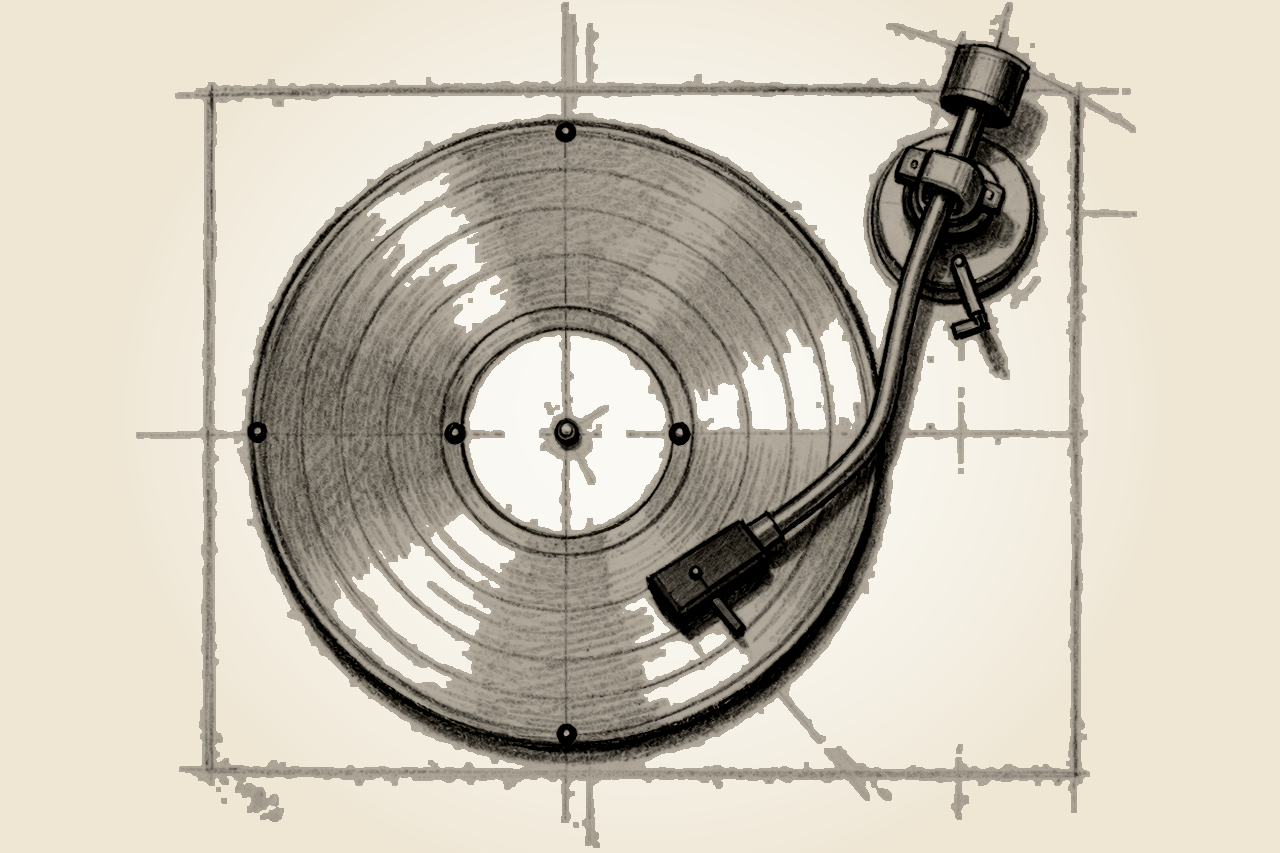
A cartridge protractor does not choose a sonic character for a record. It sets a mechanical compromise for a pivoted tonearm.
The arm carries the cartridge through an arc; the record groove follows a spiral. Those paths cannot remain perfectly tangent at every radius. Alignment geometry therefore uses two radii at which tracking-angle error reaches zero: the null points. Error remains between and beyond them. What changes from one geometry to another is its distribution across the playable area. [1][2]
This is why a record is not cut, mastered or pressed “for Baerwald” or “in Stevenson”. Moving a cartridge in its headshell does not alter the information in the groove. It changes the relationship between stylus, cantilever, arm pivot and groove during playback.
Two null points do not mean a perfect side
A two-point protractor is not marking two places where the whole record becomes optimised. It is asking you to set one complete geometry. At each null point, the stylus must land on the reference point and the cantilever must align with the grid. If the cartridge fits one point but misses the other, the intended geometry has not been achieved. Adjustment is iterative: correct one point, return to the other, and repeat until both agree. [3]
That also explains why changing geometry is more than sliding the cartridge forward or backward. For a given arm, the chosen geometry changes the combined relationship of cartridge position, overhang and offset angle. A different template means resetting that relationship, then checking both null points again.
First, name the Löfgren variant
“Löfgren” on its own is ambiguous. In practical alignment literature, Löfgren A is commonly called Baerwald. Löfgren B is a different optimisation. The useful distinction is therefore Baerwald/Löfgren A versus Löfgren B, not Baerwald versus “Löfgren” as though they were always separate settings. [2]
The figures below are approximate reference values for one commonly used IEC-style convention. They depend on the inner and outer groove radii assumed by the calculation, so they are not universal constants to copy without knowing what a template was designed to use. [2]
| Geometry | Approximate null points | Priority | What it does not establish |
|---|---|---|---|
| Baerwald / Löfgren A | 66.0 mm and 120.9 mm | A relatively even distribution of error across the assumed playing area | Zero error across a whole side, or a universal sonic advantage |
| Löfgren B | 70.3 mm and 116.6 mm | Lower weighted average error in its assumed model | Lower error at every individual radius, or audible superiority in every system |
| Stevenson | 60.3 mm and 117.4 mm | A null point closer to the inner playable area | A cure for every form of inner-groove distortion |
These are descriptions of geometric priorities, not a prediction of what a particular cartridge will sound like. The practical result still depends on alignment accuracy, stylus and cantilever condition, tracking force, anti-skate, azimuth, arm height, record condition and the cut itself.
Baerwald / Löfgren A: a broadly even compromise
Baerwald, or Löfgren A, is commonly understood as the balanced option. Rather than concentrating its benefit at one end of the side, it aims to spread the unavoidable angular error relatively evenly over the assumed playable area. [2]
Its trade-off is straightforward: it does not place its inner null point as close to the end of the side as Stevenson does. If the specific priority is to bring a null point nearer the innermost playable grooves, Baerwald/Löfgren A accepts more error there in exchange for a more even compromise elsewhere.
That is not a recommendation by genre. The available evidence does not show that Baerwald is objectively best for rock, jazz, pop, classical music or any other repertoire.
Löfgren B: a lower weighted average, not a universal winner
Löfgren B is described as a solution that reduces weighted average tracking error across its assumed playing area. Its trade-off is that reducing an average does not reduce error at every point: more of the compromise can be pushed towards the extremes of the side. [2]
The distinction matters because “lower average” can sound more decisive than it is. It belongs to a calculation with chosen groove radii and a chosen weighting method. It does not, on its own, prove that Löfgren B will be audibly better on a particular arm, with a particular cartridge, playing a particular record.
Stevenson: more attention near the end of the side
Stevenson places its inner null point closer to the innermost playable groove area. In the IEC-style reference example, that point is approximately 60.3 mm. The intended exchange is more tracking-angle error over other sections of the side in return for less of it near the end. [2]
Dr. Feickert associates this inner-groove emphasis with the possibility of climactic passages appearing late on some classical LP sides. That is a manufacturer’s explanation of the geometry’s rationale, not evidence that classical records as a category require Stevenson—or that a geometry can identify the cause of every inner-groove problem. [1]
Reduced linear speed near the label, stylus wear or profile, tracking force, anti-skate, azimuth, arm height, damaged grooves and the quality of the original cut can all matter. Stevenson changes one element of the playback geometry. It does not repair the rest of the chain.
How to choose without turning the template into mythology
Start with compatibility, not with a claimed winner. If the turntable or tonearm manufacturer specifies a geometry or provides a compatible template, that documented setup is the conservative baseline. Confirm the arm’s pivot-to-spindle distance and follow its installation documentation before adopting values from a generic protractor.
Feickert states that its Protractor NG implements Baerwald, Löfgren and Stevenson geometries and covers declared pivot-to-spindle distances from 200 to 345 mm. Those are product specifications, not proof that one option will outperform another in every arm. [1]
If the arm documentation genuinely permits a choice, keep the decision at the level of its actual trade-off:
- Choose Baerwald/Löfgren A for a relatively even compromise across the side.
- Choose Löfgren B when its lower weighted average error is the theoretical priority, while accepting that the error distribution changes at the extremes.
- Choose Stevenson when bringing a null point closer to the inner playable area is the priority, while accepting a less even distribution elsewhere.
None of these choices promises more detail, better sound in every circumstance, less record wear, or an upgrade for a particular musical genre. Geometry describes angular-error distribution; it does not settle every audible outcome.
Five errors that can invalidate the comparison
1. Using a template that does not suit the arm
A protractor must be compatible with the arm’s pivot-to-spindle distance and with the geometry it is intended to set. Do not treat a published null-point pair as a standalone instruction for every turntable.
2. Checking only one null point
Correct alignment at one grid does not guarantee correct alignment at the second. Verify both, then repeat the adjustment if either position moves out of alignment. [3]
3. Aligning the cartridge body when the cantilever disagrees
The stylus and cantilever are the relevant references for groove tracking. The cartridge body may help with visibility, but it should not override a cantilever that is visibly not parallel with it.
4. Skipping the final check after tightening
Securing the mounting screws can shift the cartridge slightly. Tighten carefully and confirm both null points again before treating the setup as complete. [3]
5. Treating geometry as a diagnosis
Changing from Baerwald to Stevenson cannot by itself reveal why a record sounds strained near the label. Poor execution of the alignment, a worn stylus, unsuitable tracking force, damaged grooves or limitations in the cut may still be involved.
What geometry cannot fix
Alignment is one playback variable. It cannot restore worn grooves, correct a damaged or worn stylus, compensate automatically for incorrect tracking force or anti-skate, or revise decisions made during cutting and mastering. It also says nothing by itself about a pressing plant, lacquer, edition or the provenance of a record.
The useful discipline for a first alignment is less dramatic and more reliable: use a tool compatible with the arm, identify the geometry it is setting, align by stylus and cantilever, verify both null points, and make no larger claim for the result than the evidence allows.