

Loudness normalisation: why a quieter master is not automatically played lower
EBU R128 and ITU-R BS.1770 explain how loudness is measured; they do not impose a universal streaming target. Using Spotify’s published policy as a dated example, this guide maps the path from master to playback gain—and the limits that prevent a simple LUFS rule.
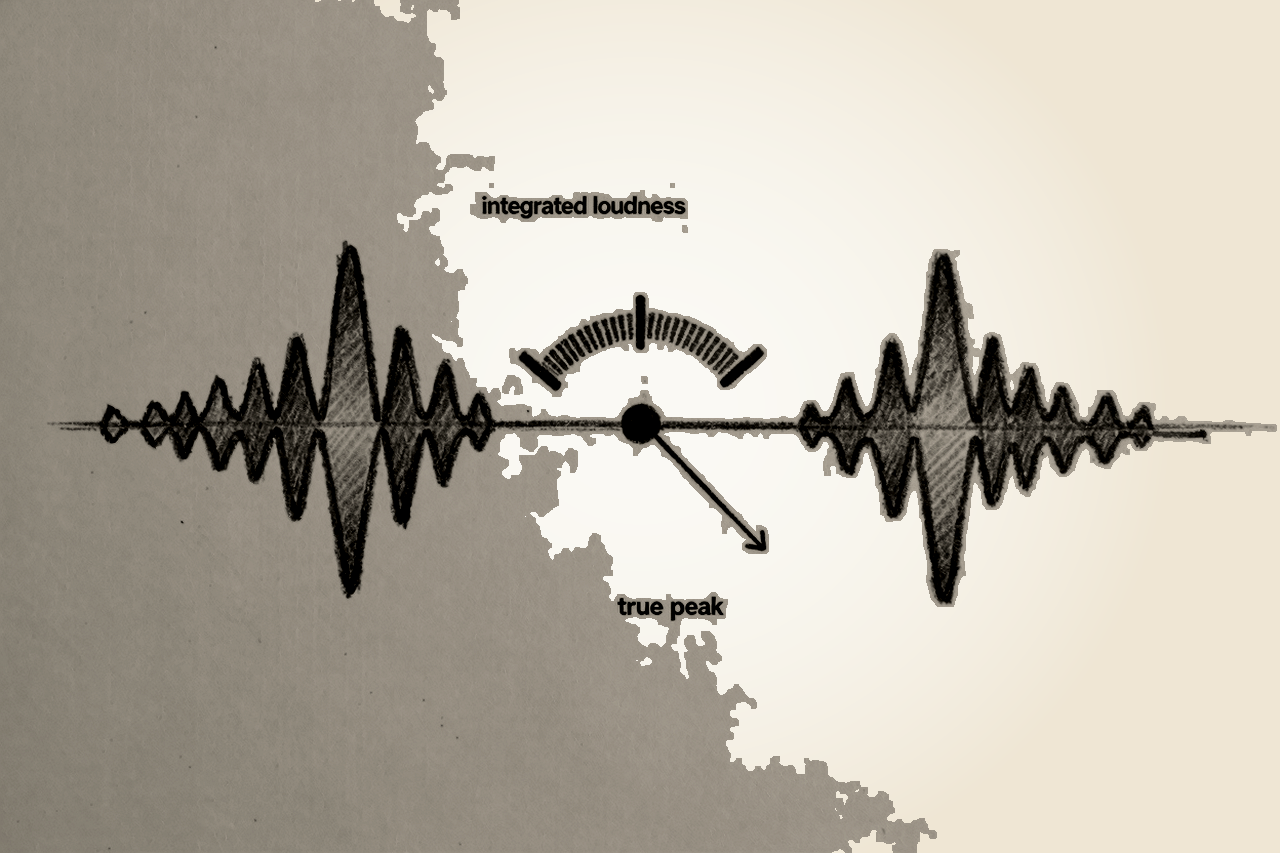
The common assumption is that a quieter master must remain quieter on a streaming service, or at least be reduced less. Target-based loudness normalisation does not work that way in principle.
The relevant path is mastered file → loudness measurement → platform target → playback gain → possible signal limits. Peak level is part of the picture, but it is not the sole decision-maker. Separate those stages and the apparent contradiction disappears.
Peak level, loudness and playback level are different things
A sample peak is the highest represented digital sample level. True peak estimates the maximum level after reconstruction. Integrated loudness describes a programme over time using a specified measurement method. These are related signal descriptors, but one cannot reliably be derived from either of the others.[1][2]
Two tracks can therefore approach similar maximum levels while measuring differently in integrated loudness. Compression, limiting, temporal density and the distribution of energy can affect that measurement. A normalisation system built around loudness does not need to apply the same correction just because two files have similar peaks.
ITU-R BS.1770 defines algorithms for measuring programme loudness and true peak. EBU R128 applies that measurement family within broadcasting and audiovisual production, where it recommends a programme-loudness target of −23.0 LUFS.[1][3][2] That figure is not a universal streaming target.
From measurement to gain
As a conceptual model, the direction of a loudness correction can be written as:
gain = target loudness − measured integrated loudness
This is not a measurement of Spotify, a particular device or a particular file. It simply describes the logic of a target. With a hypothetical target of −14 LUFS, a track measured at −18 LUFS is 4 LU below it. In an unrestricted linear implementation, that points to roughly +4 dB of gain. A track measured at −10 LUFS is 4 LU above the same target, pointing to roughly −4 dB.
The useful part is the sign: below-target material points towards an increase; above-target material points towards attenuation. Loudness normalisation is not, by definition, a command to turn every master down.
The arithmetic does not guarantee the final output of a platform. Headroom, true peak, limiting and service-specific processing can restrict upward gain or otherwise alter the operational result. The equation explains the intended direction of correction, not the exact treatment of a specific upload.
Where R128 ends and platform policy begins
R128 was developed for broadcasting and programme production. It recommends normalising programme loudness to −23 LUFS and treats integrated loudness, loudness range and maximum true peak as distinct descriptors.[1][4] It addresses a broadcast problem: avoiding large programme-to-programme differences in average perceived level that peak-only practice cannot resolve.
Streaming services may use BS.1770-based measurement, but they set their own targets, modes and processing conditions. It is therefore inaccurate to say that a music platform simply “uses R128” when the documented connection is the underlying ITU measurement approach rather than R128’s broadcast target.
Spotify is an example, not a universal rule
Spotify’s artist documentation included in the evidence package describes normalisation based on ITU 1770 and lists targets of −11 dB LUFS for Loud, −14 dB LUFS for Normal and −19 dB LUFS for Quiet.[5] Its listener support also documents volume normalisation and describes Loud as a setting for noisier surroundings.[6]
Those figures belong to Spotify’s published policy, not to streaming as a whole. The same artist documentation says that the target does not depend on maximum true peak alone and describes limiter use in certain low-dynamic-range cases.[5] That caveat matters especially when gain would otherwise move upward: a file may sit below a target in integrated loudness yet encounter a headroom or processing constraint on the way up.
These are values published in the Spotify documentation consulted for this evidence package in September 2025. Spotify may revise target values, mode names and processing conditions. Another service requires its own primary documentation before any comparison can be made.
What matching a target does not do
Global gain changes level. It does not restore transients removed by limiting, reverse clipping, undo compression or make two tonal balances alike. Bringing two tracks towards a similar measured loudness does not make their mastering decisions equivalent.
That also limits what can be claimed about listening. The measurement logic and the published gain policy can be described; the evidence package contains no controlled listening tests or independent measurements of particular tracks. It does not support a universal claim that one LUFS value will sound better, more dynamic or more impactful than another.
A practical publishing check
- Name the destination. A target only has meaning when the service and playback mode are specified.
- Measure integrated loudness and true peak separately. BS.1770-based practice treats them as different quantities.[3][2]
- Do not use a peak figure as a substitute for integrated loudness. It cannot predict a loudness-normalisation result on its own.
- Use target-minus-measurement maths for direction, not certainty. Positive gain means “towards an increase” in the conceptual model; it does not prove that every implementation can supply the full increase.
- Do not turn one platform’s target into a mastering law. R128’s −23 LUFS and Spotify’s published targets belong to different systems and purposes.[1][5]
The decision worth keeping
Mastering louder can still change a file’s dynamics, transient behaviour and headroom. What it does not automatically secure is a playback-level advantage where normalisation is active. The durable question is not “what number wins?” but “which measurement, target and processing policy does this playback path use?”
That is where loudness stops being a slogan and becomes a compatibility problem that can be checked.