

Why turning down the amplifier cannot fix clipped digital EQ
An EQ boost can overload a constrained digital stage even at a modest listening level. Follow the signal path: identify where peaks are raised, where the output range is limited, and whether attenuation is applied early enough.
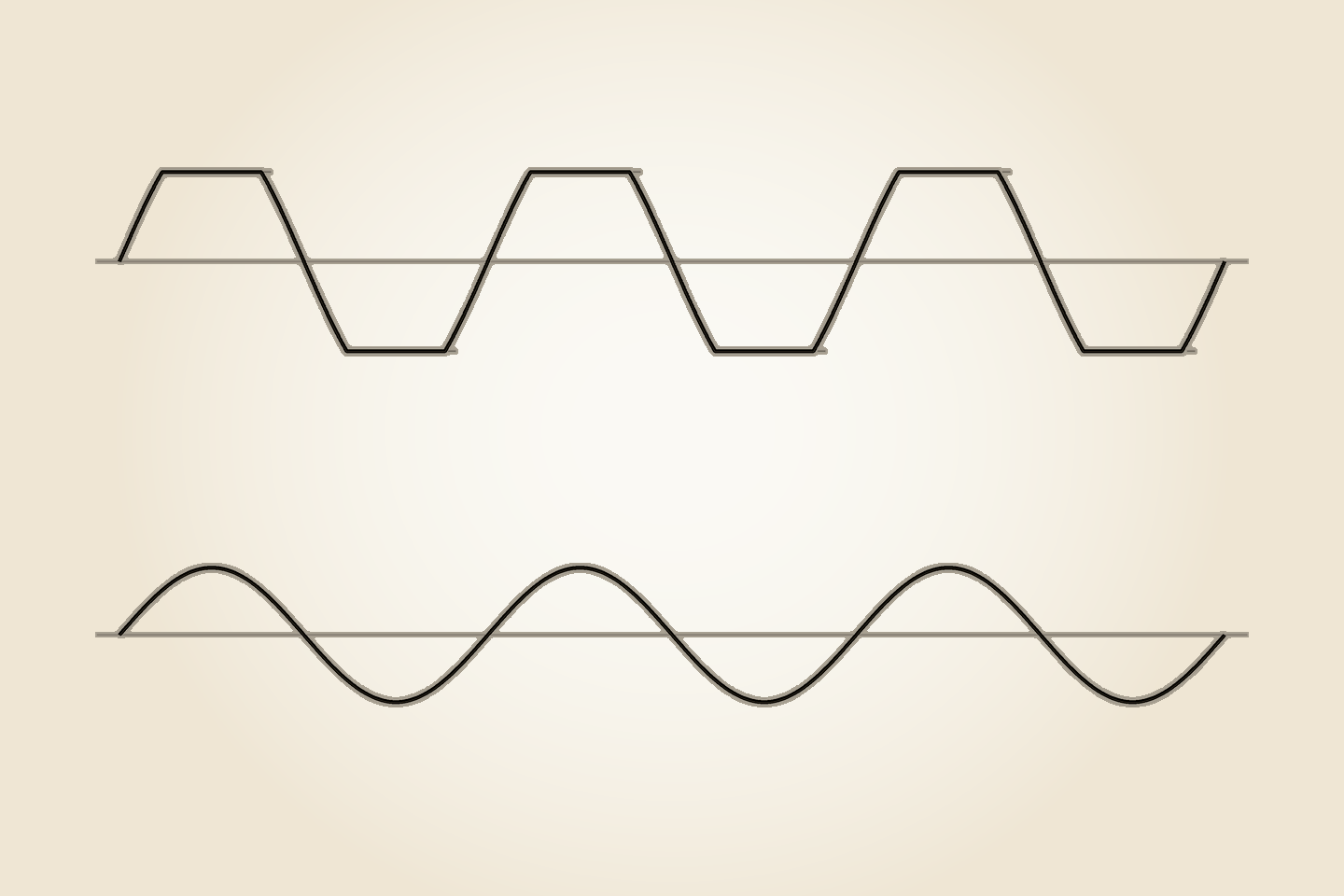
A low listening level does not necessarily mean that the digital signal is intact. The amplifier’s volume control reduces the analogue level sent to the loudspeakers, but it sits after the DAC and after any earlier digital stage that may already have constrained a peak. Once samples have been clipped upstream, lowering the amplifier cannot recreate their missing shape.
That distinction matters whenever digital EQ includes positive gain. The useful map is: source or streaming service, playback software, DSP and EQ, a digital output or conversion stage with a bounded valid range, DAC, analogue volume control and amplifier. The overload may occur long before the control used for everyday listening.
Low volume, damaged peak
Digital processing can raise peak level. A filter that boosts part of the spectrum may push a waveform beyond the range accepted by a later stage. The architecture varies across applications and devices: a floating-point processing block need not have the same limits or behaviour as a PCM output, digital interface, DAC input or conversion stage. It is therefore inaccurate to say that every internal DSP operation clips at 0 dBFS.
The narrower point is more useful: where a stage must deliver samples within a bounded range, attenuation before the processing that raises peaks can keep those peaks from reaching that stage out of range. A later analogue attenuation cannot undo a digital limitation that has already happened.
Roon documents this order for its own DSP implementation. Its Headroom Management applies attenuation before other DSP processing and is linked to a clipping indicator. Roon presents −3 dB as a starting point, not as a guarantee for every filter configuration or every track.[1] That documentation describes Roon’s signal path, not the behaviour of every player, streamer or DAC.
What an ideal +6 dB example can show
Consider one deliberately narrow case: a steady sine wave with a peak level of −6 dBFS. In a normalised amplitude representation, that is approximately 0.501 of full scale. A +6 dB gain corresponds to an amplitude multiplier of about 1.995.
0.501 × 1.995 ≈ 1.00
For that single sine wave, assuming an effective +6 dB gain at exactly that frequency, the result lands approximately at 0 dBFS. The arithmetic shows why an EQ boost may need room elsewhere in the chain. It does not mean that every +6 dB preset requires exactly 6 dB of headroom.
Music is not one stationary sine wave. Transients, simultaneous frequency components, phase relationships and the interaction of several filters can create peaks that this one-tone example does not predict. Sample-rate conversion and reconstruction-related behaviour add another concern: Roon warns about intersample overs in the context of its own DSP system.[1] Sample clipping, intersample peaks and analogue overload are related risks, but they are not interchangeable diagnoses.
Why the largest displayed boost does not decide the margin
One EQ band is only part of a configuration. Other boosts, shelves, crossovers, channel processing and overlapping filters can change the aggregate response. Room EQ Wizard documents its Filters trace as the combined response of the configured filters, making it more informative than inspecting one gain value in isolation.[2]
That combined response is still not a complete prediction of programme peaks. It describes the configured filters, not every transient in a recording, every phase-dependent sum, every subsequent conversion process or the behaviour of hardware outside the software. Treat it as a configuration check, not a safety certificate.
A stated maximum boost such as “+6 dB” therefore cannot, by itself, specify a safe headroom value for arbitrary programme material. It supports a bounded calculation. It does not replace checking actual output behaviour with the diagnostic tools available in the application.
A signal-path method, not a fixed number
The following sequence is conditional by design. It helps locate the problem; it does not assume that every application exposes the same controls or documents the same stages.
1. Identify processing that can raise peaks
Look for positive EQ gain, correction filters with boosts, crossfeed, upsampling or other DSP blocks that may change peak level. A boost is not automatically a problem, but it creates a reason to inspect the available margin.
2. Find the constrained output stage in the documentation
Identify where the software or endpoint states that output must remain within a permitted sample range. This may be an application’s PCM output, a digital endpoint or another explicitly documented hand-off. Do not infer the limits of a proprietary internal DSP engine solely from the presence of a 0 dBFS meter.
3. Place attenuation before the peak-raising block
If the software permits it, reduce level before the EQ or other processing that creates the excess. In Roon, that is the documented role of Headroom Management.[1] A downstream digital volume control may or may not be early enough; its usefulness depends on the application’s documented order of operations.
4. Review the combined filter response
Where the software provides an aggregate filter trace, inspect it for stacked or overlapping boosts that are easy to miss band by band. This checks the configuration, not the peaks of every recording.[2]
5. Use the available clipping indication as an operational check
Roon provides a clipping indicator for the path it monitors and advises increasing headroom if clipping is indicated.[1] That is useful evidence about Roon’s monitored path. It does not, by itself, establish that no overload exists in every DAC, downstream analogue input or undocumented processing stage.
What the amplifier control does solve
The amplifier’s volume control still has an essential job: it sets the subsequent analogue level and, therefore, the listening level. It may also help avoid driving an amplifier or loudspeaker too hard. What it cannot do is repair a waveform that a prior digital stage has already flattened or otherwise constrained.
The principle is simple even when a proprietary interface is not: address a digital overload at, or before, the stage where peaks are raised and the chain reaches a bounded output. Use analogue volume afterwards for playback level.
Evidence boundary
This article does not claim that a particular attenuation value is audibly transparent, audibly harmful or sufficient for every system. The cited material documents Roon’s implementation, its clipping indicator and its suggested −3 dB starting point, alongside REW’s description of a combined filter trace.[1][2] It does not provide controlled audibility comparisons, published measurements of a reader-specific signal chain or a device-independent map of internal DSP limits.
Use the documentation for the playback software, endpoint and DAC actually in the chain. If that documentation does not disclose processing order or the monitored clipping point, treat any fixed headroom figure as a conservative configuration choice rather than a demonstrated guarantee.