

Denon DP-500BT: how to choose between Bluetooth, RCA and phono input
The Denon DP-500BT can make a first vinyl system easier to assemble, but its usefulness depends on what sits at the other end of the connection. Here is how to choose its signal path without mistaking convenience for a promise of better sound.

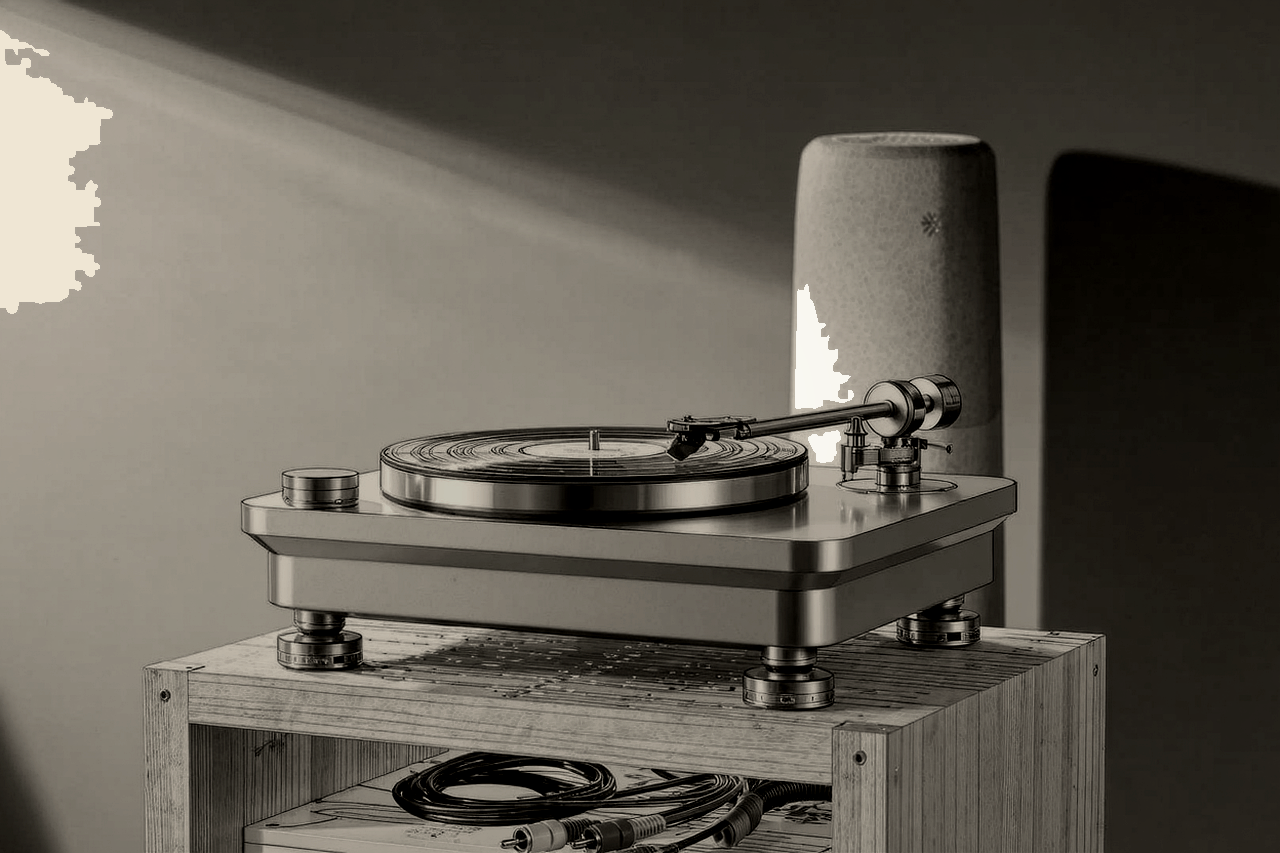
A turntable is only the beginning of the playback chain. After the stylus reads the groove, the signal still has to pass through a phono stage, amplification and, finally, speakers or headphones. The Denon DP-500BT brings several of those decisions together: it is a belt-drive, semi-automatic turntable with three speeds, RCA output, a switchable phono stage and Bluetooth transmission.[1][2][3]
That combination can make vinyl less intimidating for a first system. But the claim needs to stay precise. Bluetooth changes how the signal reaches the listening device; it does not, by itself, demonstrate an improvement in the sound of the record. The useful question is not whether one connection is universally superior, but which route fits the equipment already in the room.
What the DP-500BT changes: fewer decisions in a first vinyl system
The documented feature set is straightforward. The DP-500BT plays 33⅓, 45 and 78 rpm records, uses belt drive and lifts the tonearm at the end of a side.[1][2][3] It can send the signal to a compatible Bluetooth receiver or through RCA cables to the rest of a system.[1][3]
The built-in phono stage matters just as much as Bluetooth. It gives the owner an option for systems with a line-level input, while the turntable’s switchable design also accommodates systems that provide a phono input. The right setting depends on the input at the receiving component, so both manuals should be checked before anything is connected.[3][4]
Three signal paths, three questions before you connect anything
1. Will you listen through Bluetooth headphones or a Bluetooth speaker?
If so, the receiver matters as much as the turntable. Denon lists SBC, aptX, aptX HD and aptX Adaptive compatibility for the DP-500BT.[1][2][3] That does not mean every Bluetooth speaker or pair of headphones supports those codecs. Compatibility has to exist at both ends of the connection.
Bluetooth can reduce cable clutter and make placement easier in a simple system. It also adds a wireless transmission stage to the chain. The codec ultimately used, the receiving device and the listening environment all remain part of the result. It is therefore inaccurate to treat Bluetooth as automatically equivalent to RCA, or as proof of uncompromised sound.
2. Does the receiving system have a line input?
RCA is the wired route to an amplifier, powered speaker or other component. When the receiving device expects a line-level signal, the DP-500BT’s integrated phono stage may provide the practical route, provided its switch is set as the manual specifies.[3][4]
The important distinction is that not every pair of RCA sockets performs the same task. A phono input and a line input are designed for different signal conditions. Before playing a record, identify which input is being used rather than assuming that any RCA connection will work in the same way.
3. Does the amplifier already have a phono input?
If the amplifier provides a phono input, consult the manuals for both products to select the appropriate route and phono-stage setting.[3][4] A built-in phono stage creates flexibility, not a universal connection recipe. The point is to avoid applying phono equalisation and gain twice, or omitting the required phono stage altogether.
Bluetooth: documented convenience, conditional result
The clearest benefit of the DP-500BT is integration. The record remains the physical source, while the final stretch to the speaker or headphones can be wireless. That can suit a room where a cable run is impractical, or a household already organised around Bluetooth listening devices.
What it does not change is the mastering, pressing or provenance of the record itself. No album is associated with this product, and the available documentation does not provide independent measurements comparing its RCA and Bluetooth paths. Bluetooth is a feature of one section of the playback chain, not a quality inherent to vinyl.
The built-in phono stage is not a minor detail
A phono cartridge does not deliver the same type of signal as a conventional line-level source. That is why the phono-stage switch deserves attention before the first record, especially when the turntable is being added to an existing amplifier or active-speaker setup.
If the receiving component has a line input, follow Denon’s instructions for using the turntable’s integrated phono stage. If the component has a dedicated phono input, check both manuals before changing the setting.[3][4] This is less dramatic than a specification-sheet debate, but it is the decision most likely to determine whether a new system works as intended.
Semi-automatic does not mean fully automatic
Denon documents automatic tonearm lift at the end of the record.[1][3] That should not be rewritten as automatic return unless the applicable manual explicitly confirms it. A semi-automatic function can prevent the stylus from remaining in the run-out groove without performing every subsequent operation.
Speed selection also remains the owner’s responsibility. The DP-500BT supports 33⅓, 45 and 78 rpm records.[1][2][3] For cartridge setup, tracking force and anti-skate, use the manual supplied for the relevant regional version rather than relying on conflicting secondary specifications.[4]
Checklist before the first record
- Choose the destination first: Bluetooth, a line input or a phono input.
- If using Bluetooth, confirm that the receiving headphones or speaker support Bluetooth and check codec support at both ends if that matters to you.[1][2][3]
- Check the manuals before selecting the integrated phono-stage setting or connecting RCA cables.[3][4]
- Place the turntable on a stable surface and follow Denon’s placement guidance, including sensible separation from speakers.[4]
- Select 33⅓, 45 or 78 rpm according to the record label.[1][2][3]
- Confirm cartridge setup, tracking force and anti-skate in the applicable manual before use.[4]
- Do not assume Bluetooth follows the same signal route as RCA.
What the documentation does not yet establish
The available material does not support a verdict on sound quality, speed accuracy, isolation, phono-stage performance or the superiority of one connection over another. It also does not settle a universal European price, regional availability, cartridge model, weight, dimensions or a single wow-and-flutter figure. Some of those details differ across secondary sources and regional listings.
The firmer conclusion is also the more useful one. The Denon DP-500BT combines belt drive, semi-automatic operation, a switchable phono stage, RCA output and Bluetooth transmission in a single entry point.[1][2][3] Its value depends on choosing the right signal route for the system around it. It does not make a wireless link an upgrade to the record, but it can reduce the number of decisions required to begin playing one.