

2.83 V or 1 W? The sensitivity figure that depends on impedance
A sensitivity rating becomes comparable only when its input reference and measurement conditions travel with the decibel figure. Here is the arithmetic, the limit of the conversion, and a safer way to read loudspeaker specifications.

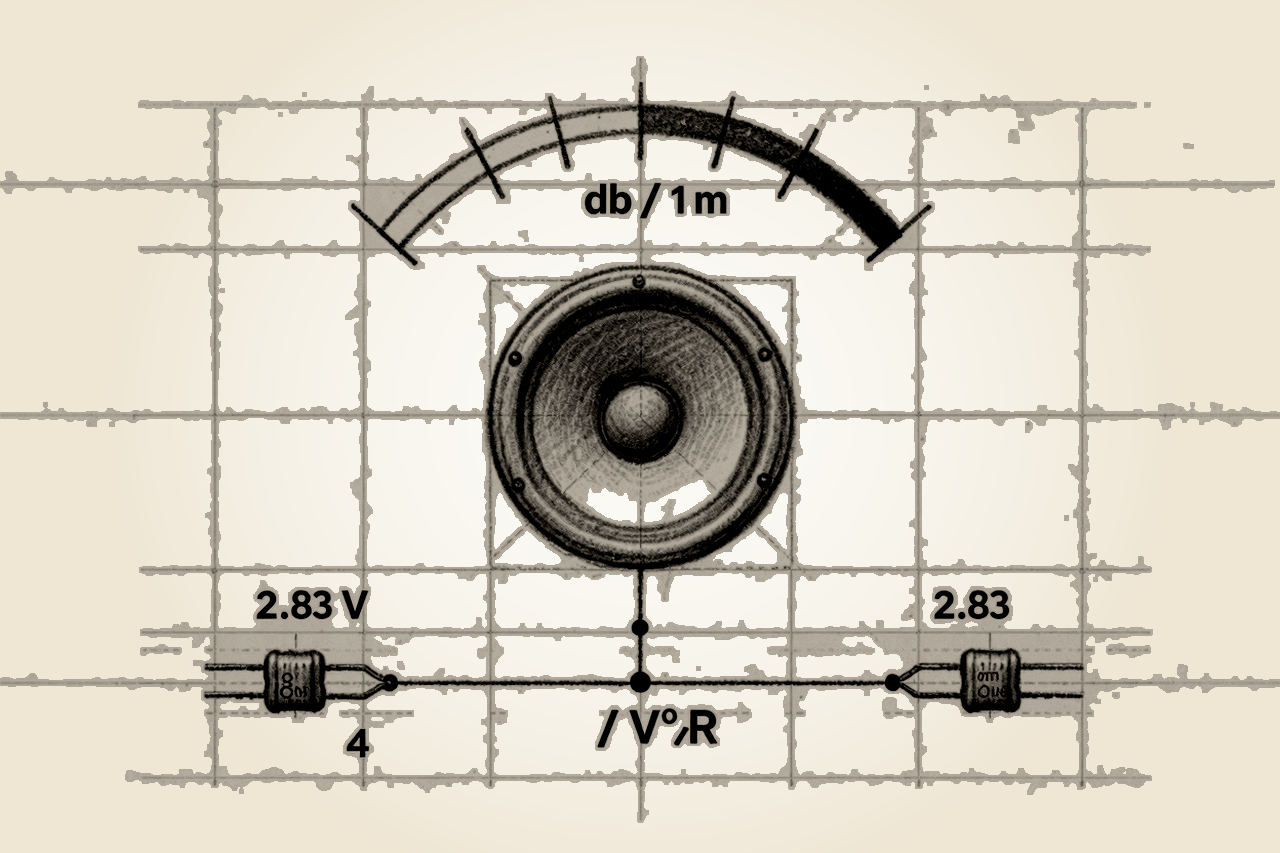
The phrase “2.83 V equals 1 W” is useful shorthand, but it drops the condition that makes it true. More precisely: 2.83 V RMS dissipates approximately 1 W in an 8-ohm resistive load. That is why dB/2.83 V/1 m and dB/1 W/1 m have often been treated as interchangeable for nominally 8-ohm loudspeakers. They are not universally interchangeable. [1]
The distinction matters when nominal impedances differ. A sensitivity figure can look like a direct statement about loudness; it is instead a sound-pressure level measured under an electrical reference, at a stated distance, using a particular method. Change the electrical reference and the comparison may change with it.
The sentence that needs a condition
For an ideal resistive load:
P = V² / R
Here, P is power in watts, V is RMS voltage, and R is resistance in ohms.
With 2.83 V applied to 8 ohms:
2.83² / 8 ≈ 1 W
That is the origin of the convention. Dynaudio’s explanation of loudspeaker sensitivity likewise connects the 1-watt and 2.83-volt references, while stressing that the equivalence depends on an 8-ohm load. [1]
Apply the same voltage to a nominal 4-ohm load:
2.83² / 4 ≈ 2 W
The voltage has not changed, but in this ideal calculation the electrical power has doubled because the load impedance has halved.
A loudspeaker specified at 86 dB/2.83 V/1 m with a nominal impedance of 4 ohms should therefore not automatically be described as an 86 dB/1 W/1 m loudspeaker. Under the nominal-resistance approximation, its 2.83 V reference corresponds to roughly 2 W. Halving electrical power from 2 W to 1 W is approximately 3 dB, making the indicative 1 W equivalent 83 dB/1 W/1 m—not 86 dB/1 W/1 m.
What a sensitivity figure actually says
Sensitivity is not a forecast of how loud a loudspeaker will seem in a domestic room. It is an SPL result under defined conditions: an input reference, a distance, and a measurement method. Documentation may also identify the measuring axis, frequency range or averaging, test signal, and acoustic environment. If those details are absent, the dB number is less informative than it first appears.
- dB is the reported sound-pressure level.
- 2.83 V or 1 W is the electrical input reference.
- 1 m is the stated measurement distance.
These terms do not describe tonal balance, distortion, directivity, bass extension, or subjective quality. Nor are sensitivity and electro-acoustic efficiency the same metric. Sensitivity describes SPL for a defined stimulus; efficiency describes the conversion of electrical power into acoustic power.
Why nominal impedance does not finish the calculation
The examples above use resistance because they make the principle clear. A real loudspeaker is not a fixed resistor. Its impedance varies with frequency and its electrical behaviour can include reactive phase. Dynaudio also notes that loudspeaker impedance is not constant, while an amplifier’s volume control fundamentally regulates voltage rather than fixed wattage. [1]
A conversion based on nominal impedance is therefore an orientation tool, not a reconstruction of exact power absorbed across the frequency range. A loudspeaker labelled 4 ohms can present higher or lower impedance at particular frequencies. Without an impedance curve and relevant signal conditions, a single exact absorbed-power figure would be unjustified.
The practical rule is modest: when two loudspeakers have different nominal impedances, read their dB/2.83 V figures as voltage-referenced specifications. Do not treat them automatically as equal-power specifications.
What the figure can—and cannot—say about a system
Sensitivity can support a first estimate of output for a target level under comparable stated conditions. It cannot, by itself, establish whether a loudspeaker is an easy or difficult load for an amplifier.
That judgement also requires impedance minima, phase angle, the amplifier’s documented behaviour, listening distance, desired peak level, and programme dynamics. Two loudspeakers with the same sensitivity can therefore impose materially different electrical demands. Equally, a lower dB/1 W figure does not by itself make a loudspeaker unsuitable for a particular amplifier.
The room is a separate variable. Moving the loudspeaker does not alter its published sensitivity rating, but it can alter SPL and spectral balance at the listening position. Distance, placement near walls or corners, directivity, reflections, and room modes all matter. Sensitivity alone supplies no universal room correction.
Checklist: comparing two sensitivity ratings
- Input reference: Is the rating dB/2.83 V/1 m or dB/1 W/1 m?
- Nominal impedance: In the ideal resistive calculation, 2.83 V is about 1 W at 8 ohms and about 2 W at 4 ohms.
- Measurement conditions: Does the documentation state distance, axis, frequency range or average, signal, and acoustic environment?
- Impedance data: Is a minimum impedance, or preferably an impedance curve, published?
- System context: Are listening distance, required peak level, and amplifier behaviour known?
If a nominal 4-ohm loudspeaker is listed at 90 dB/2.83 V/1 m, the careful reading is exactly that: 90 dB at 2.83 V and 1 m, under the manufacturer’s stated method—or with the method unspecified. It is not automatically 90 dB per watt. The approximate 3 dB conversion to a nominal 1 W reference can orient a comparison, but it remains idealised until the impedance-versus-frequency behaviour and measurement method are known.
Technical glossary
- Voltage reference: an input condition stated in volts RMS, such as 2.83 V.
- Power reference: an input condition stated in watts, such as 1 W; its voltage depends on the load.
- Nominal impedance: a label for the loudspeaker’s intended impedance class, not a fixed resistance at every frequency.
- SPL: sound-pressure level, reported here in decibels.
The calibrated verdict
The familiar equivalence holds with its omitted condition restored: 2.83 V RMS is approximately 1 W only into an 8-ohm resistive load. On a nominal 4-ohm load, the same voltage corresponds ideally to about 2 W. [1]
Neither convention is inherently misleading. A voltage reference is a valid reference, and amplifiers apply voltage. But a sensitivity number supports a fair comparison only when its reference is explicit—and when the reader does not ask it to predict more than the measurement can show.