

Loudness, loudness range and dynamic range are three different measurements
Avoid the mix-up: neither a single LUFS number nor the loudness range alone can reveal the dynamic quality of a recording. Each metric measures something different and under specific technical conditions.

Evidence boundary: This explainer defines measurement terms from ITU-R and EBU documents. It does not grade a master, infer artistic quality from a meter, or claim a LineaSonora listening comparison.[1][2][3]
Three questions, not one score
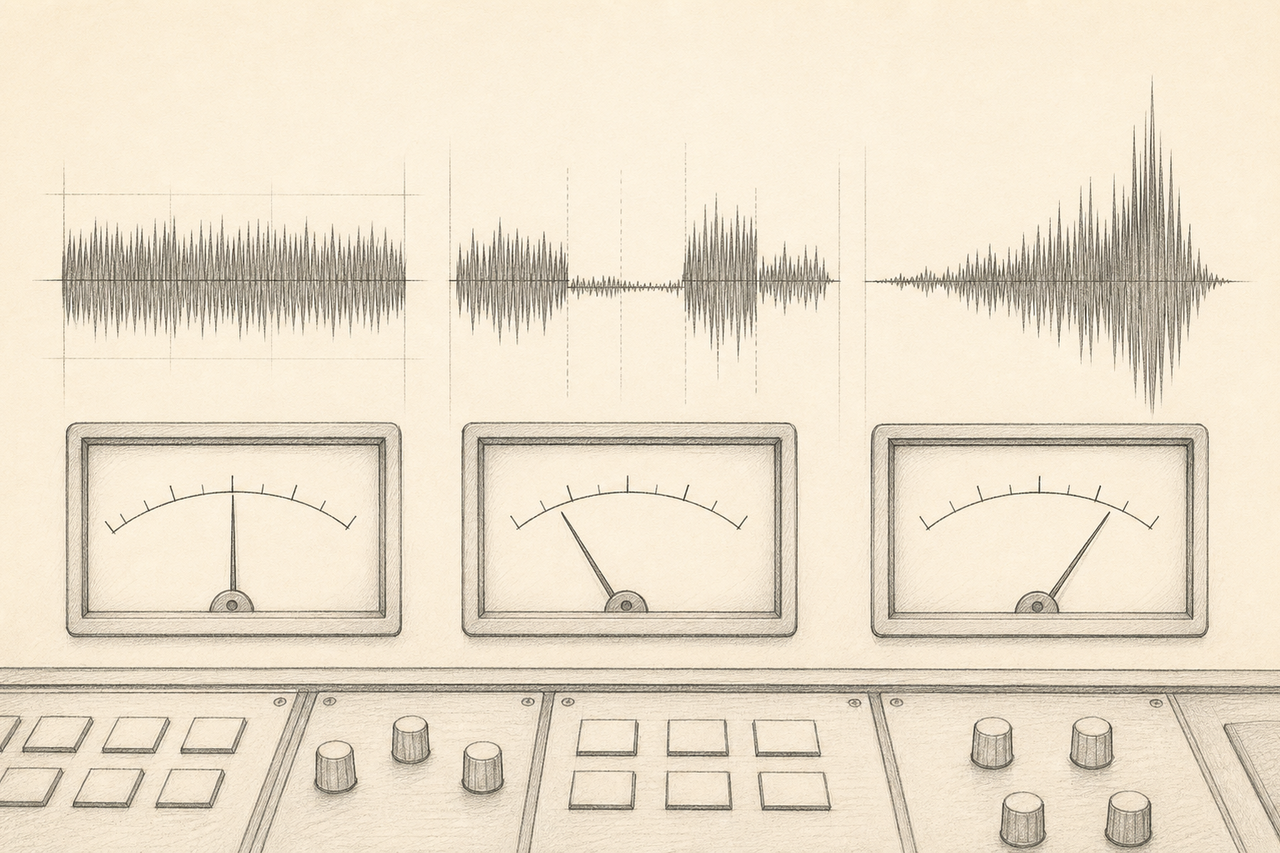
Programme loudness asks how loud a complete programme measures under a defined algorithm. Loudness Range (LRA) describes the statistical variation of loudness across that programme. Dynamic range is broader and must be defined before use: it may refer to the span between noise and maximum level, a level distribution, a crest-related measure or a musically interpreted contrast. Treating the three as synonyms produces false conclusions.
What ITU-R BS.1770 establishes
ITU-R BS.1770 specifies algorithms for programme loudness and true-peak audio level.[1] A compliant meter applies the defined channel summation and frequency weighting. The result answers a measurement question under that method; it does not say whether a mix is balanced, exciting or faithful.
True peak addresses potential maxima of the reconstructed signal. It is not a dynamics score. Two files can share a similar true peak while having very different level distributions, and two files at similar integrated loudness can preserve very different transient and sectional contrasts.
What EBU R 128 and LRA add
EBU R 128 combines Programme Loudness, Loudness Range and Maximum True Peak Level for loudness normalisation in broadcast workflows.[2] Its target and tolerances serve that operational purpose; they are not a universal mastering prescription for every music service.
EBU Tech 3342 defines LRA as a statistical descriptor designed to estimate variation in loudness while reducing the influence of extremes.[3] That makes LRA useful for comparing programmes under consistent conditions, but it does not inventory every transient or reveal why a passage sounds more or less contrasted.
Why the same LUFS value can describe different music
Integrated programme loudness compresses a time-varying work into one result. A sparse recording and a dense recording can land on similar values after level adjustment even if their envelopes, arrangements and peak structure differ. LRA adds another view, yet a single LRA value still cannot identify clipping, tonal balance, microdynamics or the artistic role of compression.
Use the metric that matches the question
- For delivery loudness, state the BS.1770 version, programme boundary and integrated result.
- For headroom, record true peak and the measurement settings.
- For variation across a programme, report LRA under a named method.
- For “dynamic range,” define the calculation instead of publishing an unexplained score.
- For artistic judgment, use documented listening and production context in addition to measurements.
A defensible reporting template
Write: “This file measures X LUFS integrated, Y LU LRA and Z dBTP under the stated meter and programme boundary.” Then explain what those figures can and cannot answer. Do not turn “louder,” “wider LRA” or “higher peak” into an automatic claim of better sound.