

WiiM Ultra: what this streaming preamplifier does—and cannot solve on its own
The available documentation places the WiiM Ultra between network streaming, DAC conversion and preamplification. Here is what WiiM declares, what still depends on the rest of the system, and why it should not be mistaken for an amplifier or a vinyl release.

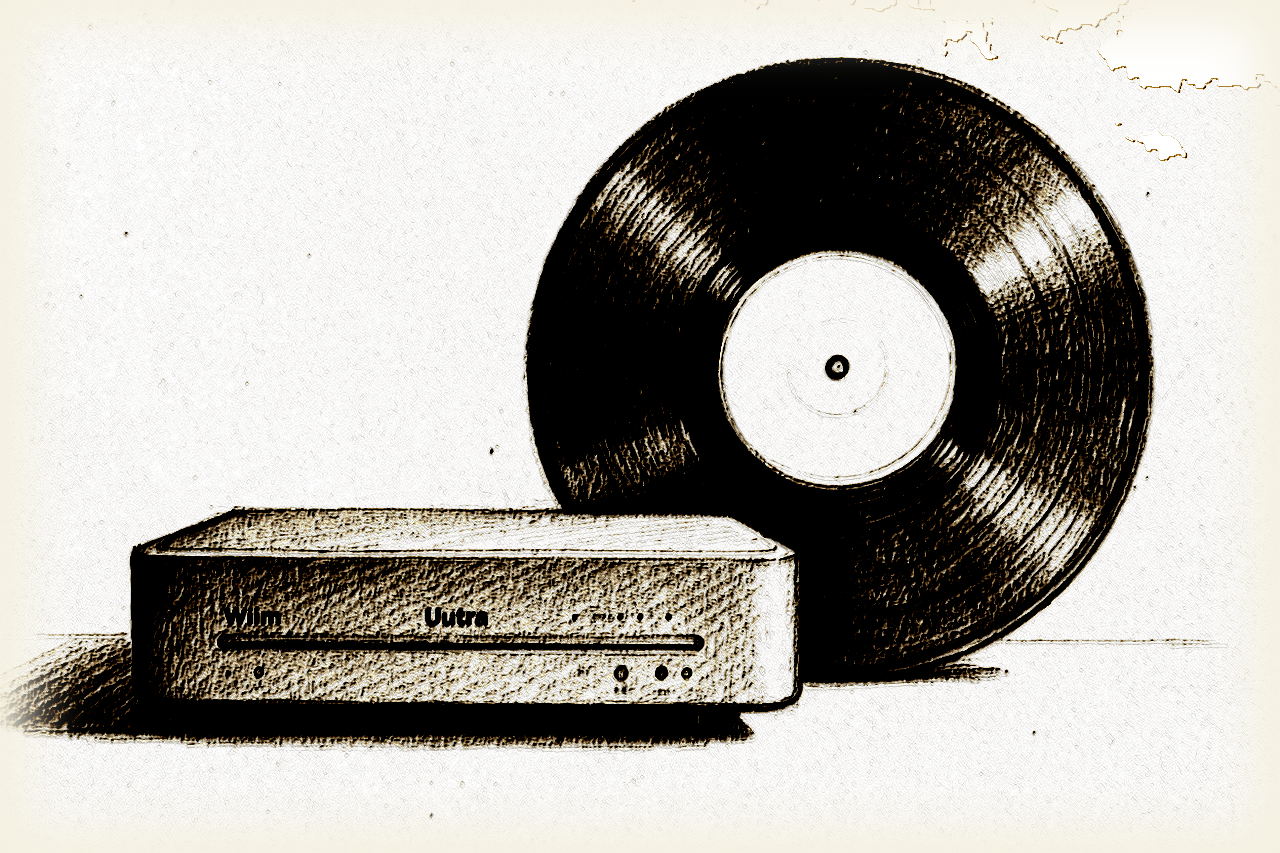
The first clarification is simple but necessary: the WiiM Ultra is not a vinyl release, a record edition or a mastering story. It is a network-audio component. WiiM presents it as a hub for music and television, while its documentation and the supplied specialist coverage place it in the category of streaming preamplifier with an integrated DAC.[1][2][3]
That changes the useful question. Rather than asking what it might do for a particular pressing, ask where it sits in a mixed system: which sources it can bring together, which controls it can centralise, and which parts of the final result still belong to the amplifier, loudspeakers, room, network and turntable setup.
A hub is not a complete hi-fi system
WiiM documents network streaming, DAC and preamplifier functions, a touchscreen, WiiM Home app control, analogue and digital connectivity, and HDMI ARC for a television source.[2][3] The same material lists Spotify Connect, TIDAL Connect, Google Cast and Roon Ready among the supported platforms.[2][3]
Those functions overlap, but they are not interchangeable. A streamer accesses or receives digital music. A DAC converts digital audio to analogue. A preamplifier selects sources and manages level. A power amplifier provides the power required by passive loudspeakers.
The WiiM Ultra can therefore occupy several roles in one enclosure, and may reduce the number of boxes between sources and amplification. It does not eliminate the need for suitable amplification and loudspeakers, unless the loudspeakers themselves contain their own amplification. WiiM’s description of the unit as a digital hub is a statement of product positioning, not evidence that it completes every hi-fi system.[2]
What the documentation establishes
The useful facts are functional ones: the Ultra is intended to centralise streaming and connected sources; it includes DAC and preamplifier duties; and it offers app, screen and television integration within the documented feature set.[2][3] For a listener moving between records, television audio and streaming services, that is the practical appeal of the category.
It is worth keeping a firm line between those documented functions and performance claims. The supplied material includes manufacturer and retailer specifications concerning resolution and measured performance, but this packet does not include independent LineaSonora measurements or a controlled listening assessment. Such figures should be read as declared specifications, not as proof of an audible outcome in an unfamiliar system.
A technical maximum cannot describe the quality of a recording, the behaviour of an amplifier, the placement of loudspeakers or the acoustics of a room. Nor does it establish that adding one digital component will make a turntable system more persuasive.
If a turntable remains part of the system
A turntable should be considered through its signal path, not as just another source on a connection chart. Before adding any central preamplifier or streamer, establish where phono gain and equalisation are handled in the existing setup, then check that the available inputs and outputs suit that arrangement. The evidence supplied here does not establish universal compatibility with every cartridge, phono stage, amplifier, television or active-speaker system.[2][3]
That distinction matters. Cartridge alignment, tracking force, loading and gain belong to the analogue chain; network streaming functions address another part of the system. A hub can make source selection more orderly, but it cannot correct an unsuitable cartridge match or a poorly adjusted turntable.
There is no basis in the available evidence for claiming that routing a record through the WiiM Ultra improves dynamics, texture or continuity. Any audible result would depend on the complete chain, including the phono stage where relevant, the signal route, amplification, loudspeakers, room and setup. That is an editorial observation about system dependence, not a listening report.
Services, network use and the AirPlay question
The stated support for Spotify Connect, TIDAL Connect, Google Cast and Roon Ready gives the Ultra a documented place in several streaming ecosystems.[2][3] It does not make compatibility universal: the relevant question is whether those services and control methods match the listener’s own devices, subscription and daily habits.
AirPlay deserves particular attention. The secondary sources included with this article indicate that the WiiM Ultra does not operate as an AirPlay or AirPlay 2 receiver.[4] This is a reported limitation in those sources, not a prediction about every future firmware version or every Apple-related workflow.
For any specific installation, the current manual and product documentation remain the appropriate references for ports, operating procedures and restrictions.[2][3] The supplied evidence does not identify one firmware version governing every function mentioned here, so an older retailer listing should not be treated as a complete compatibility map.
What this product cannot tell us
The available sources support a concise description: the WiiM Ultra is a streaming preamplifier with an integrated DAC, network functions and connections intended to centralise several sources. They do not support a LineaSonora listening review, a claim of superiority over separate components, or a conclusion that the unit will improve a turntable system.
The Audiophilia item that prompted this assignment is a review of a digital music streamer, not evidence of a vinyl edition or a documented mastering and pressing chain.[1] That boundary is important. This is a component whose value depends on integration, not a record whose provenance can be assessed through credits, mastering notes or pressing information.
For a system that includes both records and streaming, the modest approach is usually the sound one: map the signal path, identify which component performs each job, verify the required services and connections, and avoid assigning a system-wide transformation to one hub. In analogue playback, adjustment and matching matter. In network audio, category and compatibility matter just as much.